Seven Dials Society
The Seven Dials MysteryThe Seven Dials Society is an amateur intelligence network that uses secret meetings and numbered identities to help Superintendent Battle’s Department pursue a dangerous thief. Its theatrical secrecy encourages Bundle Brent to mistake it for a criminal organization, but its members are not the conspirators she suspects: they are volunteers who knowingly undertake dangerous work on behalf of their country. Their investigation succeeds, though two of its members die before the criminal is caught.
Origins and Mandate
The society began with Gerald Wade, who approached Superintendent Battle with the idea of forming a group of young people to perform amateur secret-service work. Battle warned that the undertaking could be dangerous and made clear that anyone joining must accept that risk. Wade’s friends joined regardless. The origin therefore lies not in a shadowy organization recruiting unsuspecting followers, but in an acknowledged partnership between an experienced official and volunteers willing to act where excitement and service converged.
Battle later explains the group’s purpose through the case that brought it together. A highly dangerous thief, operating in the world Wade knew, had stolen valuable secret inventions twice. The thefts appeared to require inside knowledge, and the professionals had tried and failed to identify the culprit. The Seven Dials Society took up the pursuit and eventually helped bring the thief to justice. Its work was not a private game: the stakes were international, and the danger was real.
The distinction between amateur and professional remains central to the organization’s identity. Battle describes the members as people drawn both to danger and to an honest wish to serve their country. He regards their contribution as work his Department could not have accomplished in the same way. Their amateur status does not mean that Battle leaves them uninformed about the risk; it marks the unusual method by which he supplements formal investigation with a small, committed network.
Members and Numbered Identities
At the final introduction, Battle makes the society’s membership legible by identifying its people and their numbers. Mr. Mosgorovsky, whom Bundle has encountered through the club, runs that establishment and other operations; Battle identifies him as his most valuable secret anti-Bolshevist agent in England. No. 5 is Count Andras of the Hungarian Embassy, a close friend of the late Gerald Wade. No. 4 is the American journalist Mr. Hayward Phelps, whose British sympathies and instinct for news make him useful to the work.
Bill Eversleigh is revealed as No. 3. No. 2 is an empty place: it belonged to Ronald Devereux, whom Battle calls a gallant young man who died for his country. No. 1 was Gerald Wade, who died in the same service. The position passed, with Battle’s serious reservations, to a woman who proved her fitness and helped the organization: Countess Radzky. She removes her mask at the introduction, revealing herself to Bundle, who had assumed that the Countess’s apparent foreign-adventuress persona was genuine.
This numbered roll makes absence part of the society’s structure as well as its history. The empty chair for Ronald and the transfer of Gerald’s place show that the membership list records losses, not merely assignments. The numbering also supports the group’s concealed identity at meetings, while the final unveiling reverses the assumptions through which Bundle has tried to interpret it.
Secrecy, Exposure, and Danger
The society’s secrecy has practical consequences. When Bundle asks Scotland Yard about secret societies, Battle answers cautiously that the police try to keep their information current. He urges her to leave the matter to professionals; she counters that an amateur has the advantage of being able to work in the dark. That exchange anticipates the society’s uneasy position: its work depends on operating beyond the ordinary view, even as Bundle’s independent investigation brings her close to it.
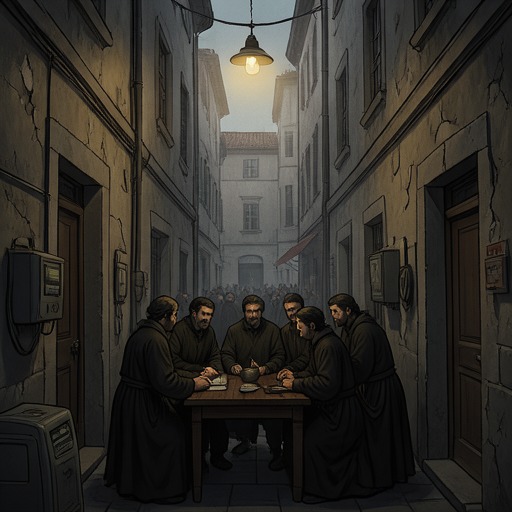
At a secret meeting, Mosgorovsky warns that too much is becoming known about the group and its meeting place, and says that people who suspect them must be silenced. Bundle, listening unseen, feels the threat personally. The remark helps explain why the society’s secrecy seems criminal from her vantage point; she does not yet know who is speaking, what the group serves, or who its actual enemy is. In the same meeting, members discuss plans for their scheme and the discovery of Gerald Wade’s letter referring to the organization. They also consider the coming inquest into Ronald Devereux’s death and a widely circulated account that local young men had been practising with rifles. The meeting thus shows secrecy at once as operational protection and as a source of frightening misdirection.
Success, Loss, and Significance
The society’s achievement is inseparable from its casualties. Battle tells Bundle that the criminal was dangerous, that two lives fell victim to him, and that he nevertheless got away with it for a time. The members persisted; with Bill Eversleigh’s help, the man was eventually caught red-handed. Battle names him as Jimmy Thesiger, whose arrest that afternoon completes the pursuit. The revelation turns Bundle’s former investigative partner into the organization’s target and clarifies how badly appearances have distorted her understanding.
The Seven Dials Society is therefore both a working network and a deliberate counter-image to the secret criminal syndicate Bundle expects to find. Its masks, numbered places, and dramatic meetings resemble the conventions of a hidden empire, but Battle’s account relocates their meaning: these trappings belong to a team of amateurs assisting public service, not to a criminal mastermind’s followers. The resemblance is not harmless. The society operates amid real theft, murder, suspicion, and danger, and its members pay for their commitment. Its theatrical form gives the story its mystery, while its revealed purpose makes the central contrast one between concealed appearances and the loyalties those appearances hide.